The Salon
To receive our full newsletter, scroll to subscribe.In the meantime, enjoy our Op-Eds below.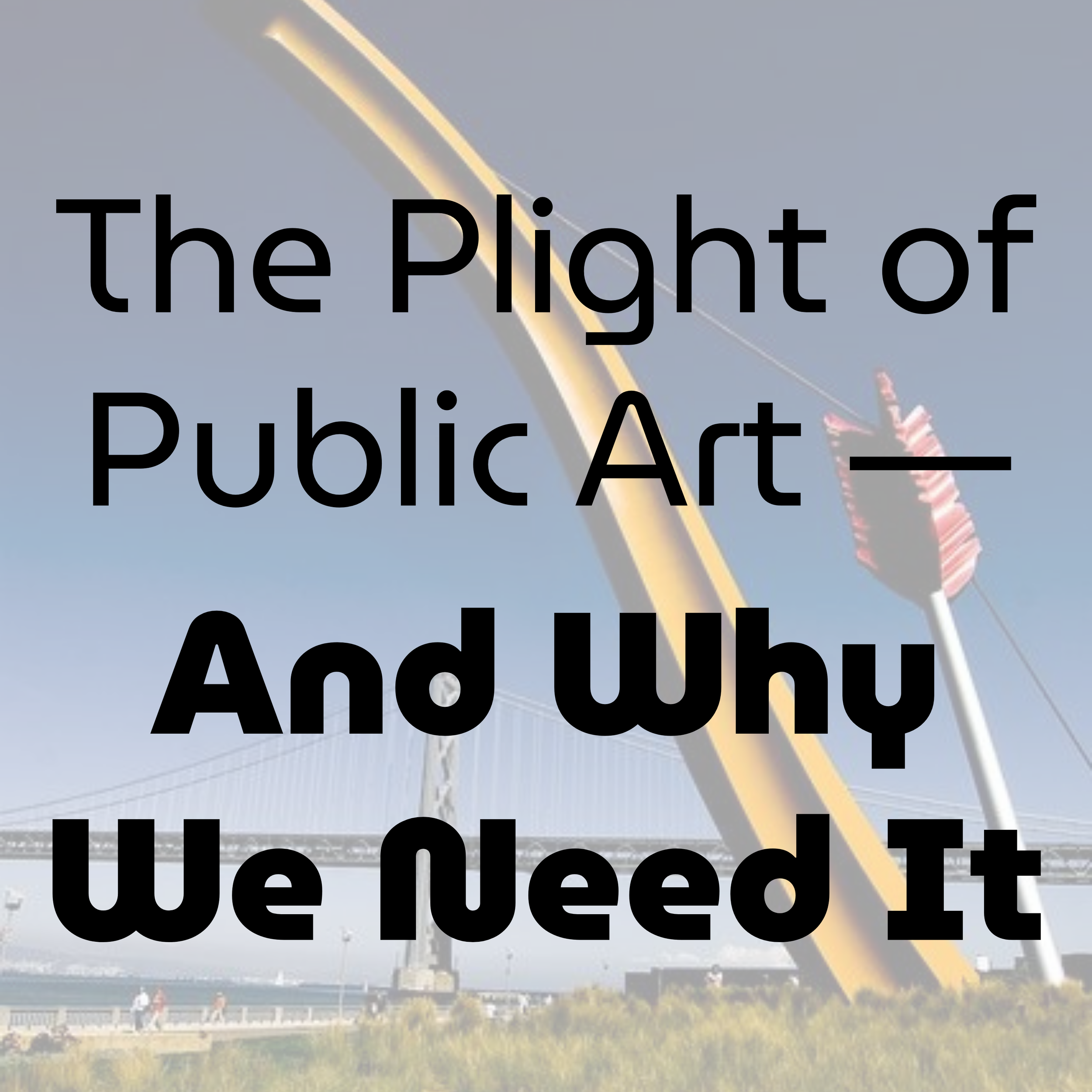
The Plight of Public Art — And Why We Need It
The Plight of Public Art - And Why We Need It
If you have ever walked along the Embarcadero in San Francisco, you have likely stopped at the sight of the monumental bow and arrow planted in the grass along the waterfront. Titled Cupid’s Span and created by Claes Oldenburg and Coosje van Bruggen, the sculpture is playful, striking, and impossible to miss. It nods to San Francisco’s reputation as a “port of love,” both a literal harbor and a cultural epicenter of love, freedom, and creative possibility, shaped by the Summer of Love, the enduring spirit of Haight Ashbury, and the uplifting of the LGBTQ+ community. The city’s loving feeling is reinforced by a landscape that feels inherently romantic, where mountains meet the ocean and fog wraps the city in a familiar embrace. The sculpture does more than just decorate a lawn. It anchors memory. It signals identity. It gives shape to a feeling. It creates a distinct link from the past to the present. That is why public art matters.When we remove public art, we do not simply clear space. We erase symbols, stories, and shared reference points. When we fail to place art, we fail to connect people with space and ideas. Still, in cities across the country, public art is treated as expendable.Municipalities country-wide are facing budget shortfalls and are turning to cultural funding as an easy target for cuts. In Ann Arbor, the city council voted to reduce funding for its public art program as part of broader budget deliberations, a move that sparked debate about whether art is essential civic infrastructure or discretionary spending.Closer to home, reporting in the San Francisco Chronicle detailed how Oakland slashed nearly all of its cultural grants, roughly 1 percent of the city’s total budget, and eliminated its Cultural Affairs Manager position. This role was responsible for overseeing public arts programs. The cuts were cited as necessary steps to close a significant deficit.When cities are grappling with housing shortages, infrastructure needs, and public safety concerns, funding for art can appear like a luxury. Coverage in SFGate of the sea serpent sculpture Naga in Golden Gate Park highlighted the hundreds of thousands of dollars required to fabricate and maintain a large-scale public artwork. Numbers like that are easy to isolate. Unfortunately, the returns are harder to quantify.These decisions are difficult and elected officials are keen to be seen as responsive to a city’s immediate challenges. But like any leadership challenge, it focuses on the immediate over the long-term. By treating public art as a cost, it misses what public art actually accomplishes for communities. Public art does three important things to enrich communities: It removes barriers to access, it improves quality of life, and it adds economic value to the community it shares space with. By placing art directly into daily life, outside the walls of museums, galleries, and private collections, community leaders eliminate barriers to access. A child walking to school, a commuter on their way to work, and a visitor seeing a city for the first time all encounter it equally. There is no ticket price, no dress code, no prerequisite knowledge required.I spoke with Mauro Schenone Ugueto, formerly with the Public Art Fund and now at Artsy, about what public art means to him:“Public art serves as a gateway into the world of art, removing barriers and placing artworks directly into daily life. Encountering art on a commute or in an unexpected public space invites curiosity, sparks conversation among strangers, and creates moments of shared experience and common ground. In that sense, public art not only enriches cities visually, but also socially and culturally.”His point is crucial. Public art does not simply beautify. It socializes. It creates shared reference points. It becomes part of the collective language of a place.Returning to Cupid’s Span, the sculpture does not just occupy space. It helps define it. It tells visitors something about San Francisco before a single word is spoken. It reminds residents of the city’s layered identity: romantic, rebellious, hopeful, creative.There is also growing research supporting the connection between arts engagement and wellbeing. Studies from the World Health Organization and the National Endowment for the Arts link exposure to the arts with improved mental health, reduced stress, increased social cohesion, and greater civic participation. My colleague Jamie’s recent article, The Influence of Art on Wellbeing, further explores how sustained engagement with art can positively affect both psychological and physiological health.Public art amplifies those benefits because the audience is unlimited. A single sculpture can impact thousands of people every week, often in subtle but cumulative ways.Public art also supports local creative economies. It provides commissions for artists, fabricators, engineers, installers, and conservators. Research from Americans for the Arts demonstrates how arts funding circulates through local labor and business networks, strengthening economic as well as cultural resilience.At C-lective, we care about public art because we care about the entire art ecosystem. Art in the home and art in the hometown are not separate conversations. They reinforce each other. When artists receive public commissions, their practices grow. This is how we came to meet several of our now rostered artists like David Ruth and Jennifer Lugris. When communities encounter art in their daily environment, curiosity deepens. That curiosity often leads people into the arts and new creative avenues. Public art is not a distraction from civic priorities. It is part of what makes cities worth investing in. It shapes identity, fosters connection, supports creative labor, and enhances wellbeing.The more art we encounter, inside our homes and out in our streets, the more expansive our sense of possibility becomes. Public art is not an indulgence. It is an invitation to better communities and better living. It is one we cannot afford to lose.
Smart Collecting: Love Local
Smart Collecting: Love Local
Artsy recently published an article describing fine art shipping as a “necessary evil.” They quote gallerists and logistics firms who agree that the cost of shipping is the industry’s biggest, “dirty little secret”. This may be salacious language, but it is an excellent report on this real pain point for collectors and galleries. As someone who worked in fine art shipping at one of the largest providers, I was inspired to share some additional perspectives and point to options for making smarter choices.Fine art shipping is high stress, complex, and occasionally thrilling. I climbed over crated Monets, triple-checked shuttle logs, and designed custom client plans for cross-country and global projects whose requirements changed on a moment's notice. I saw firsthand how quickly costs multiply for artists, galleries, and collectors. Every touch along the way—packing, crating, transport, customs, installation—adds a fee. Often these fees aren’t transparent, and they become multiplied by a clients’ urgency or tight budgets. Artsy highlights several challenges that have made shipping so expensive:Persistent inflation: Freight, packing, crating, and handling costs have not returned to pre-COVID levels, even though some raw material prices have stabilized.
Complex bureaucracy: Customs, taxes, and multiple invoices make shipping confusing as well as costly.
Market impact: High logistics costs deter buyers, especially when shipping accounts for a disproportionate share of a work’s price.
Lower-priced works suffer most: Collectors often expect shipping to remain under 10 percent of an artwork’s value, a benchmark that is increasingly unrealistic.
There are additional factors not captured in the limits of a short, but excellent article. Fine art logistics has become a big-money business. Today, the global fine art logistics market is estimated at 3.5 billion dollars and is projected to grow to 6 billion through the early 2030s, with dominant players including Crozier Fine Arts, Uovo, Cadogan Tate, Dietl International, and U.S. Art Company. The scale and consolidation of these mega-shippers shape costs, timelines, and the collector experience in ways that smaller, local operations once handled more personally.Private equity has also moved into this industry, and insiders can see its effect. The local charm and craftsmanship are replaced by broad mandates for growth and profit maximization schemes. These firms are consolidating once-independent companies into global conglomerates which serve an art market, whose upper end has a reliance on global art fairs and auctions. But for local galleries, trusted relationships have disappeared and options have narrowed. Every gallery cultivates long-standing connections with lighting experts, conservators, installers, and shippers. These relationships have always been essential in an industry with surprisingly thin margins. What I learned during my time in fine art logistics is simple: shipping is not just a cost. It’s a sophisticated system that runs on expertise and relationships. I watched artists request cross-country quotes only to discover the shipping alone could exceed a month’s rent on their studio. I saw galleries change a whole show’s direction because a pivotal artwork was stuck in customs. When shipping mishaps happen, artists lose opportunities, sellers lose commissions, and collectors miss out.Here is my insider tip: buy local. Purchasing art locally is better for your wallet and your experience as a collector. You can meet the artist, see the work in person, and build a connection that scrolling and virtual galleries cannot fully replicate. You also avoid the anxiety of long shipping journeys, unexpected invoices, tax and customs complexity and potential damage.Imagine an artwork already close to your home–or already in your home, for C-lective members. No excessive packing fees, no cross-country freight bills, no customs forms. Installation is simple and often included. Your budget stretches further, allowing for custom framing or even a second piece by the same artist. At a local gallery like ours, you can even pick up the work yourself. The experience is personal, joyful, and deeply satisfying. Fine art shipping is expensive and only getting more so. Now is the moment to embrace local collecting. Supporting local artists and galleries simplifies the process, preserves the joy of interacting with art, and allows collectors to spend smarter while experiencing the full richness of art within their own communities.
Works Cited: Kazakina, Katya. “The Art Trade’s ‘Necessary Evil’ Keeps Getting More Expensive.” Artnet News, 16 Jan. 2026, https://news.artnet.com/market/art-shipping-problems-investigation-2737673.“Fine Art Logistics Market Size, Share, and Trends Analysis Report 2024–2034.” Market.us, 2025, https://market.us/report/fine-art-logistics-market/
Why You Should Buy Art (with C-lective)
Why You Should Buy Art (with C-lective)
Buying art is one of the most meaningful ways to use your money. It supports creativity, builds culture, and adds lasting value to your home and life.
At its core, collecting art is about participation. It means taking part in a living conversation about ideas, beauty, and expression. Every time you acquire a piece, you support an artist’s livelihood, strengthen the creative economy, and center community in your world.
In a time when technology and automation are changing how we live, investing in the human imagination has never been more important. Artists remind us what it means to feel, to question, and to create. Supporting them is an act of care for the world we want to live in.
Smart Collecting: Investing in Ideas and People
Buying from emerging artists is often a “low risk, high reward” investment. You are getting in early with someone whose career is just taking shape. We believe many of these artists will see their work appreciate in both market value and cultural importance.
Purchasing from established artists connects you to the evolving story of contemporary art. You become part of the circle of collectors who recognize the value in what they are creating right now. These are works that continue to be recognized as defining examples of the art of our time.
Even if a work does not rapidly increase in price, it will always increase in personal value. Living with art brings joy, reflection, and a sense of meaning every day to own it. The story and emotion behind a piece become part of your daily life, which is a return that cannot be measured in dollars, but makes your life measureably better.
Why Your Contemporaries Matter
The most respected collectors all agree on one thing: invest in your contemporaries. Historical art is important as it connects us to the past and laid the foundation for today’s creativity, but contemporary art connects us to the present moment and to living artists who are shaping culture right now.
Through C-lective, you can meet these artists, learn about their practice, and experience their work firsthand. You can form genuine relationships with the people creating the art that moves you. Imagine what it would have been like to know Monet, Roy Lichtenstein, or Frida Kahlo while they were alive. That level of personal connection is possible now, and it makes collecting infinitely more meaningful.
As you engage with one artist, you often meet others in their circle. Before long, you are part of a creative community filled with conversation, inspiration, and shared purpose. That sense of connection makes life richer for everyone involved and expands your world.
Why Do It with C-lective
C-lective was created to make art collecting more personal, ethical, and rewarding for both our members and our artists.
We have introduced a royalty system into our community, the first of its kind in the fine art industry, to ensure that artists continue to benefit from the ongoing success of their work. If you ever decide your time with an owned C-lective piece has come to an end, you can resell it within our network. You will receive proceeds from that sale, and the artist will receive a share of the appreciated value. This allows artists to continue sharing in the success of their creations long after the initial sale. Too often, artists are excluded from the profits of their own work as it moves through auctions and private sales. Many have sold early pieces for modest sums, only to see them later sell for hundreds of times that amount without receiving anything in return. We are supporting artists with a community built on transparency and long-term view on financial success.
Your membership also works for you. We credit back a portion of your membership fee toward a purchase of your choice. Membership supports our ecosystem by funding artist grants, artwork rotation operations, and community events.
We strive to have every action support artists, strengthen our community, and enrich your experience as a collector. Whether you choose to buy, or simply enjoy living with rotating art each season, you are helping to build a more sustainable creative world. Buying art keeps culture alive, deepens your connection to creativity, and welcomes new meaning into your home.
Collect smart. Collect with heart. Collect with C-lective.
The Influence of Art on Wellbeing
There's more to art than meets the eye. That is, art impacts the brain and can actually provide a host of cognitive benefits and improve overall wellbeing. We are evolutionarily wired for the arts; they are a have-to-have for our health.1 Historically, people have turned to artistic outlets around the world to prevent and treat illness, express joy, ease grief, and build community. Now, research increasingly finds that art has a statistically significant impact on improving wellbeing through social and psychological benefits, as well as progression opportunities.5
The NeuroArts Blueprint Initiative is a partnership between the Johns Hopkins International Arts + Mind Lab Center for Applied Neuroaesthetics and the Aspen Institute’s Health, Medicine & Society Program. It defines ‘neuroarts’ as the “transdisciplinary study of how the arts and aesthetic experiences measurably change the body, brain, and behavior and how this knowledge is translated into specific practices that advance health and wellbeing".4 This initiative investigates how exposure to arts of all kinds fosters interconnectivity across a vast and complex neuron network.4 This in turn, influences how we process and perceive creative experiences, due to the brain’s agility.4 Besides, what the research describes on a neurological level, art lovers describe emotionally: The sense that art changes the way a person or room feels when engaged with.
Neuroarts is the bridge between recent, revolutionary advances in technology and the artistic traditions throughout history. New imaging capacities, portable devices, and wearable sensors that allow observation of how the brain changes, nanosecond by nanosecond, in response to stimuli, provide scientific explanations and underpinnings.4 Being able to map what happens as we take in the world through all forms of sensory perception is key in understanding the ways art changes the brain, biology, and behavior. Anyone who has ever paused in front of a painting and felt their shoulders loosen instinctively or been captivated in contemplation understands what the research is now capturing in data.
"The brain systems that engage with reward, motor activity, perception, and the senses are stimulated by art in ways unmatched by anything else." 4
Participating in art has a positive effect on various cognitive functions. For instance, drawing improves concentration and memory. Drawing also stimulates the brain’s creative processes; in turn helping with problem-solving skills and the ability to think outside of stereotypes.2 This participation in art can have a calming effect, reducing stress and improving overall sense of wellbeing.2 Notably, it's not only making art yourself that provides a psychological benefit, but participating in the arts as the beholder enhances health and wellbeing by expressions of self, experience, imagination, and creativity.4 When you look closely at a work of art, your brain can begin to mimic the neural activity of the artist who created it. New neural pathways form and a state of inspiration is stimulated that accordingly has a positive impact on consciousness, self-reflection, and personal memories.2 There’s no need to be a master painter or ceramist to be rewarded with the wellbeing influences of art. Sometimes witnessing someone else’s expression is what allows you to understand your own. Artists’ vulnerability by way of their work makes space for an immense level of understanding, just by attending a gallery show or museum–where most people commonly experience art. Making personal connections with contemporaries is all the more valuable cognitively, as insights into artwork deepen so do the opportunities for neuro stimulation and benefits accordingly.
Engaging in arts and culture in your everyday life can encourage physical activity, reduce stress and isolation, and help with substance recovery processes.6 Thus, The Massachusetts Cultural Council started the Culture Rx Initiative with the aim of formally integrating art into public health and social care systems.6 Arts on Prescription programs are one way to improve psychosocial wellbeing with this approach.5 Art in community spaces can become a lifeline or something to hold on to and engage with in difficult times without demanding anything in return. Neuroarts helps harness and mobilize the biological impacts of art as well as realize the potential of art in this context. The science helps explain why a space or home infused with art feels more alive, comforting, and reflective of the people present there.
The World Health Organization finds evidence of the contribution of the arts to the promotion of good health and the prevention of a range of mental and physical health conditions.3 C-lective offers the optimal way to gain that necessary interaction of art in your day to day life. The introduction of fresh pieces of art quarterly provides constant art connection in your own home rather than few and far between stimuli you encounter at the occasional museum visit. Furthermore, the rotating gallery model is more invigorating for the brain than a single, permanent piece of art. C-lective makes experiencing new art accessible with different artworks installed throughout the year. Living with art isn’t passive; it’s an ongoing relationship that evolves as you do, revealing new details and moments of discovery. Since C-lective connects with each member to understand their preferences, tastes, and knowledge regarding fine art, every art piece is carefully curated to pave the way to an enjoyable, yet new and thought-provoking experience. Interacting with art can shape not just the brain but the texture of everyday life. The ability to have psychologically stimulating contemporary art at home is the privilege C-lective provides, while you reap the art’s health and wellbeing benefits.